

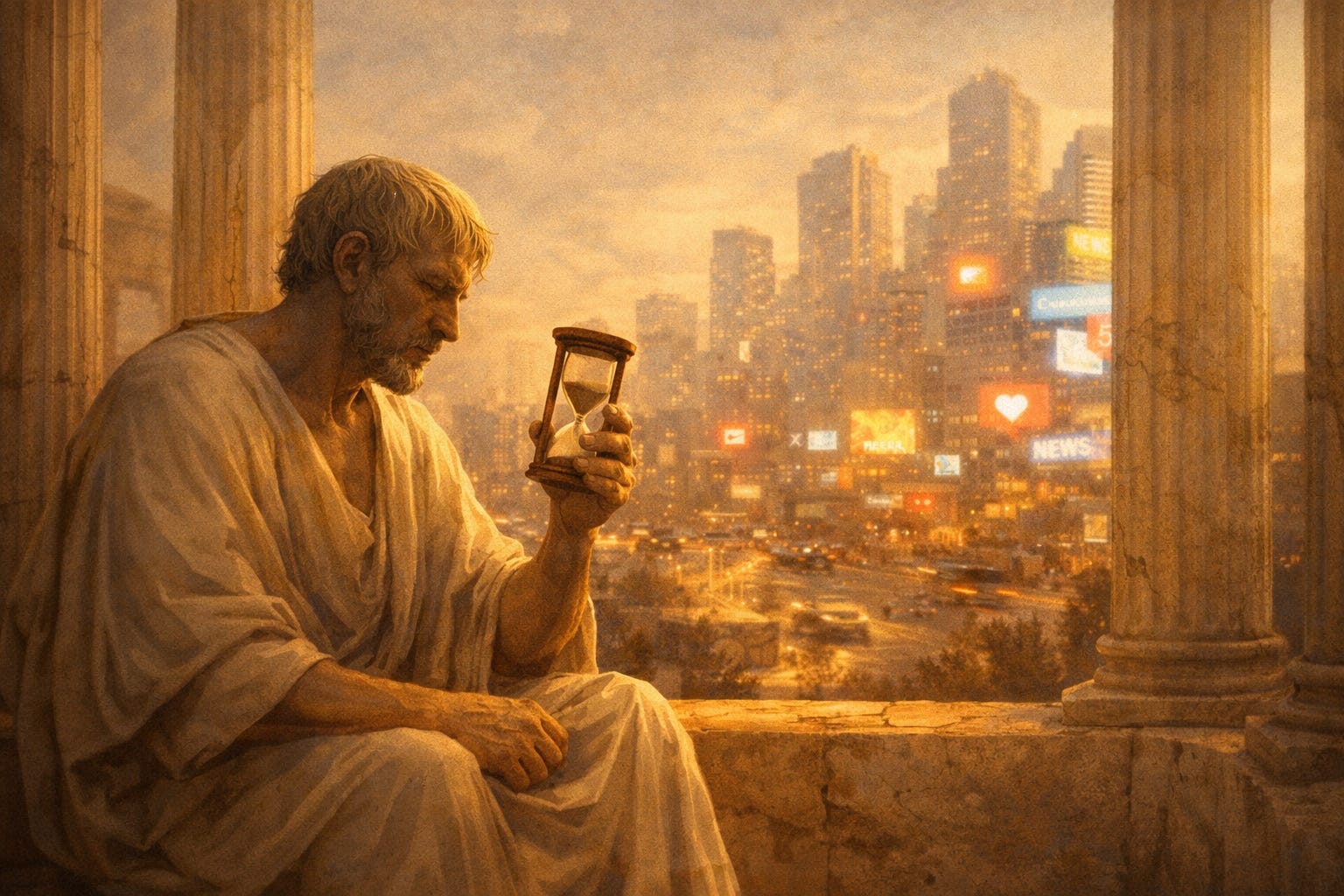
About 2000 years ago, in ancient Rome, a famous Stoic philosopher wrote an essay on one eternal topic: the finitude of human life. Two thousand years later, Seneca’s “On the Shortness of Life” is still as valid. His diagnosis still feels uncomfortably accurate – a life well spent can by no means be defined as short or not enough, it’s just that people find too many ways to waste it.
It’s quite remarkable that 2000 years later, despite our progress in such a great variety of domains, we still can’t properly articulate ourselves in relation to the one thing that defines us all: time. And whilst Seneca spots the problem with great precision & accuracy, our modern-day caveat is that his ancient prescriptions live in a world that no longer exists.
Let us first take a deep dive into what the ancient Stoic gets right to this day & imagine that we are his friend Paulinus, to whom he writes the essay:
“The problem, Paulinus, is not that we have a short life, but that we waste time”.
Seneca argues that people from all walks of life find ways to waste the majority of their lives as if they are not finite. We spend too much time on empty desires for pleasure & vanity, chasing approval, enslaving ourselves by serving other people’s interests or the worst according to Seneca - indulging in vices, being greedy or angry on meaningless matters.
It’s fascinating how much efforts & value we give to wealth & material possessions that can be lost & remade, but how “frivolous we are with the most valuable thing in the world, blind to its value because it is intangible, because it cannot be seen”.
We act immortal in our desires & aspirations, often postponing life & the things that truly matter to us. We don’t live for ourselves and we complain about it, as if it’s not us who take every path & decision. We lack agency for our time, and we justify this by blindly following the expectations of society.
Due to the variety of methods to misuse our time, we operate in a constant state of business, even if “it is universally agreed that no single worthwhile goal can be successfully pursued by a man who is occupied with many tasks”. A busy person can’t be the master of anything; the default mood of the busy man is misery. Our state of constant rush between the present and the future does not leave us with enough time to hear ourselves.
This is where Seneca starts to feed us his suggested remedies. A well-spent life is one full of meaning and our life isn’t short if we are to live with purpose. To obtain both, we need to save our time & protect it as our most precious asset. We need to study our own internal world, our unique values and drivers. If we successfully do this, we’d have enough time to achieve all our major personal accomplishments.
The Stoic recommends that we steer away from the ephemerality of the present & the uncertainty of the future. We need to retreat & put our focus on the only certain thing – the immortal knowledge of the past. We need to study the wisdom of the great people of history and make them our mentors - “you may dispute with Socrates, question Carneades, find equanimity with Epicurus”.
Unlike your present acquaintances & friends, the knowledge of the past cannot betray you - it will be your trusted guide on how to live well. He goes on further to suggest that this is where real agency lives – “you can’t choose your parents, but you can choose your mentors”.
But whilst Seneca’s essay validates its argument on the immortality of knowledge with its own soundness 2000 years later, his particular solution fails to escape the city walls of ancient Rome. Because unlike Paulinus, our present-day time & life challenges exist in a much more complex world.
Two millennia ago, the “withdraw and study” was a valid strategy that the ancient Romans could take. The world had significantly less distractions, limited career options and social comparison was restricted to your local community & peers. Most likely the wealthy Roman elite could retreat and study, whilst their slaves & subordinates continued to fulfil their basic human & social needs.
But how do you “withdraw” if you need to pay a mortgage? Or face any of the modern challenges that no human faced even a century ago? Seneca did not live in a world where an abundance of legitimate career & life trajectory options were widely accessible to everyone. Our unprecedented access to information technology allows us to compare with the entire world, not just our peers.
Every day we learn about a new successful person but blindly skip the fact that they dedicated a significant amount of time to achieve their current objective and most likely will have to spend a similar amount on their next one. Instead, our social feed is already showing us the next example, and the next, and then a few more…
This combination of optionality, social comparison and inability to withdraw creates a sense of speed & urgency that did not exist in ancient Rome. And the current AI revolution is only accelerating it - the term “decision paralysis” has surged 6x in the last five years in Google keyword searches. We are scared to decide, because the opportunity cost of not choosing the very best appears to be getting more & more expensive.
This is where the gap in Seneca’s work lives. “On the Shortness of Life” fails to answer the modern questions on time. How do we choose the right thing to spend time on? What should this thing actually be? Modern life requires achieving clarity while we are building it, not instead of it. We cannot pause and simply retreat into the past, because the present will leave us behind.
In a world where AI rapidly revolutionises full industries & sectors, withdrawal does not equal clarity, but stagnation and death. Our modern society requires constant movement and adaptation; one cannot simply withdraw or stop.
Thus, Seneca’s ancient wisdom gives us partial answers to a question that has been expanding in complexity. The stoic philosopher perfectly names the eternal human disease on time & meaning, but he cannot resolve the tensions he has never lived.
Today, clarity cannot come from withdrawal & the topic lives unanswered. Does it come from clear visibility into one’s trajectory and a fine balance between the ever-expanding demands for people’s attention & time? Is clarity even compatible with the speed of change & the modern structure of life?