

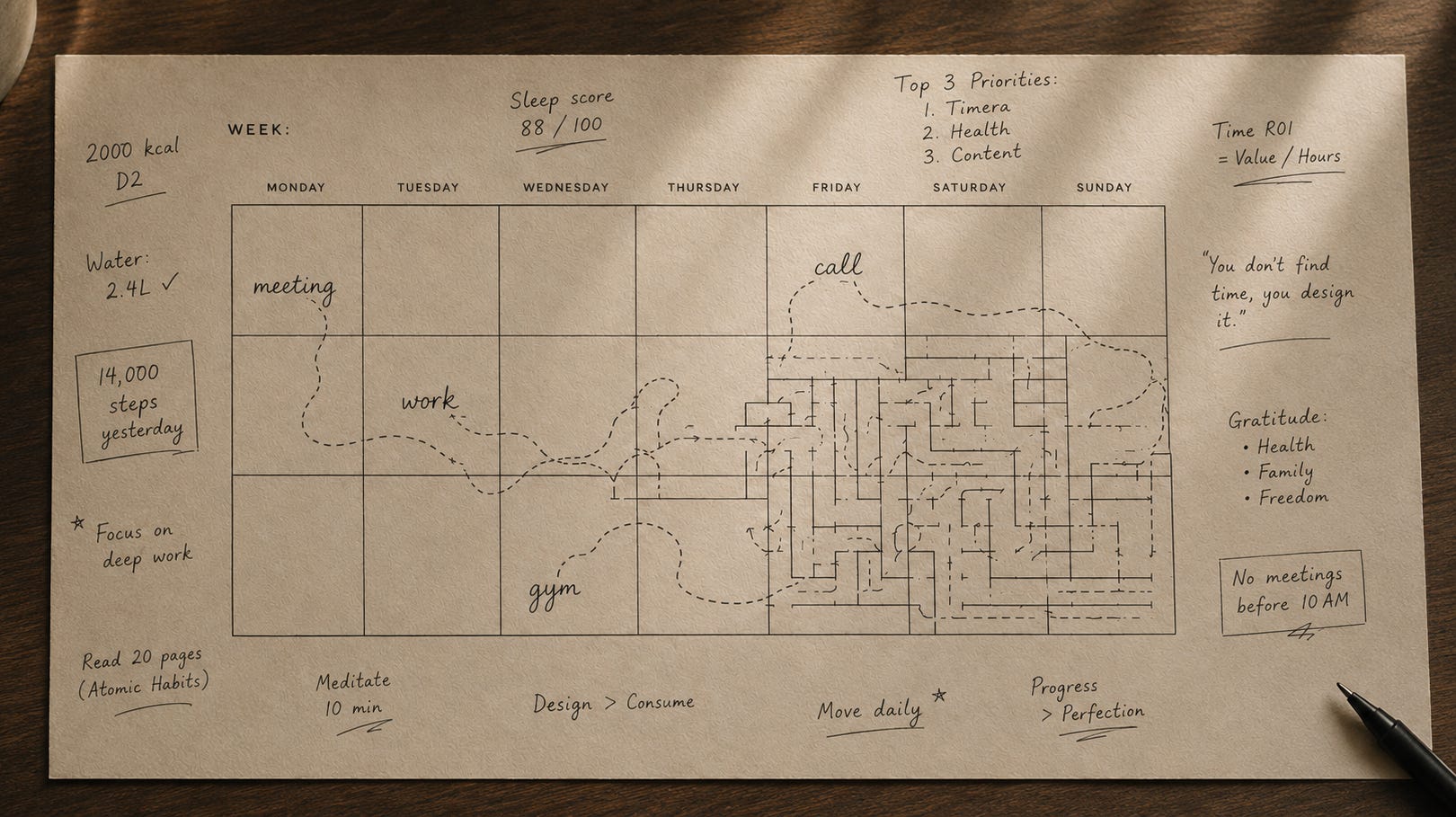
Today it’s Sunday, the 17th of May - I slept 9 hours and 21 minutes with a sleep score of 88. I will consume 2200 calories as per my deficit plan and burn about 3500 as I am playing padel at 12:00. GPT is warning me that a +1K deficit is dangerous & might result in muscle loss, but we both know it’s fine as 1.) I will hit my 190 grams protein goal and 2.) My “accidental” 3700 cal. carb load yesterday will still balance out my week to exactly 2449 cal. intake. I am well on track with my calorie cut plan as I try to repeat my last summer’s best-shape-ever results.
I could have easily written the above paragraph with precise data about my monthly budgeting, running performance, investments allocation or phone screen time. All this information enables clarity – I choose better, correct my inputs when needed and progress a lot faster on the path towards my goals. Some of you already think this sounds dystopian, whilst others know exactly what I am talking about and probably wonder how their own tracking system compares to mine.
I agree with both of you. To the latter group, I am guessing we all share first-hand examples of goals achieved thanks to data & tracking systems that prove this just works. To the first – I don’t do this alone – I am enabled by technology that makes all of this possible with minimum friction. Our world is shaped by data instruments that close a self-feeding loop of questions & answers. On the individual level – we have sport watches, longevity bracelets & a ton of mobile apps; on the global level – we have the AI revolution that is rapidly transforming entire industries and sectors. In a way, our ever-evolving ability to structure & utilize data has become central. But if this is just a game of questions and answers, shouldn’t we be asking better questions?
What do we want out of life and what are we dreaming about? Are we on track to achieve it? Are we utilizing our most limited resource – time – on the right things, people and goals? How much of our daily chase and short-term objectives align with our long-term direction?
Do we even know our long-term direction?
There is no instrument for this. There are no dashboards, KPIs or scores that give us an easy answer to any of the above. In fact, there isn’t even a name for what I am trying to describe. Yet.
Let’s call it Life Trajectory Drift or just Drift in short.
Philip Zimbardo - one of the most renowned people who studied humanity & its relationship with time, halfway through his book writes almost in passing: “It would be so good if there’s a time planner like financial planners that answer the questions - what do you want out of life? How can you make your time matter?“. But then he moves on; he doesn’t build it. And despite the relevance & eternity of the topic, nobody has. We stick to our known ways of thinking about these questions as deeply individual & we accept there are no easy answers
But why do we conform to the notion of “it’s always been this way”, when we have such a rich library of historical anecdotes for the contrary? I’ll assume you know about Ford & the “faster horses”, Sony and the Walkman or iPhone vs Blackberry, so let me take you even further back.
Let’s travel to the year 1854 on Broad Street in London, England, where the local neighbourhood is burdened by a new cholera outbreak. The majority of the population believes that the cholera is caused by air pollution coming from the rotting soil of the river Thames. They believe in the miasma theory of Hippocrates – an ancient concept that originated 23 centuries before the outbreak. They would wear scented handkerchiefs, purify the air with perfumes & herbs, try and remove all ill smells & generally avoid places with stagnant air. About 600 people would die, before John Snow would successfully map out & track all diseased homes to a nearby contaminated water pump. He would successfully persuade the local authorities to have the pump’s handle removed & gradually the outbreak will be stopped.
Whilst Snow himself admits his theory was inconclusive back then, his act of mapping the disease around a single foul water source would become a foundational moment in modern epidemiology. It would help science explain & tackle cholera through the newly forming Germ Theory of Disease that would eventually undermine the miasma theory. Once he made the contamination clear, you could not see the epidemic the same way. It was never bad air, but germs that caused death. In that sense, John Snow’s work showed that data could save lives.
And what about us and our own lives today? Perhaps we have our own miasma theory – the clean email inbox, the money in our bank accounts, the next LinkedIn promotion announcement. Are we really thrilled about it or are we doing what everyone else is, because that’s the way to go? And even if we are indeed – do we know if this is really leading us towards the life we want?
We don’t have an instrument to guide us on this quest. And if we are to try & map it out like Snow, we might see why – unlike the cholera, our five-paragraph-old query cannot be answered by a single source of contamination. Perhaps because the answers will differ about 8.3 billion times or perhaps of its inherent complexity – we have tried to tackle it with perfume-like solutions.
The existing remedies include several adjacent categories of instruments such as productivity apps, planning journals or even therapy & life coaches. All these tools absorb a legitimate demand for a real human need but spend their bullets on the wrong target. Our technology has steered towards short-term, standardized, objective productivity tools or expensive personalized experiences enabled by questionable self-help gurus.
In addition, it’s hard to market and sell something that doesn’t even have a name and Drift just got its name 600 words ago. It’s easy to sell health (steps, calories, etc.) or productivity (planners, to-do lists, etc.), but how do you sell “Are you heading where you said you wanted?”. Every instrument needs the category to exist in ordinary language first – just as credit score has creditworthiness or calories nutrition. It’s hard to market & sell something that stays hidden and invisible. And it’s nearly impossible for an entrepreneur to have the incentives to build in a space that doesn’t have a market & quite frankly doesn’t really exist. Yet.
The famous Swiss psychologist Carl Jung puts it very well – “Until you make the unconscious conscious, it will direct your life, and you will call it fate.”. For most of our history as humans, the questions of direction and Drift were unconscious by default, and they really don’t have to be.
Our modern life doesn’t really help our current quest. Defined by ever-increasing demands for speed, uncertainty and change we are forced to think short-term. Why plan long-term if the world has gone mad? Our big tech friends don’t help us either – they comfortably satisfy our cravings for 30-second dopamine shots, whilst we willingly sell our data to their advertisers. Perhaps they know that long-term clarity is incompatible with short-form content that wastes us hours every day.
It is as if clarity sits on a tall mountain peak & we prefer to take a picture with it from a far, instead of climbing it and earning it ourselves. Currently it seems much harder to plan the next 5 or 10 years instead of planning out your next calendar week whilst staying blind if its168 hours would produce a meaningful piece in your own unique life puzzle. It shouldn’t have to be this way.
You can’t climb a mountain if you don’t know it exists. You can’t summit a peak without the proper tools for it. So, if Drift is a mountain with clarity at the top, our base camp would be this essay.
There’s a famous book by Bronnie Ware - a palliative care nurse who captured the top regrets of people at their deathbeds. Surprisingly or not, the top of the list did not comprise of taken actions or events. Instead, what people regretted most were: paths they didn’t take, opportunities they didn’t grab or people that they didn’t keep. Sooner or later, we will all be in their place. We would get the chance to see our life clearly – in one big trajectory line. But by the time this happens, it will be all too late for change.
And I don’t think we should wait or act blind about it. Just as we increasingly obsess and track our tiny daily details such as calories, steps or HRV, we should utilize our newly advanced data tech to help us ask better & smarter questions. Longevity is pointless if it just extends a life of running in circles. I know with confidence that many young, bright minds around me feel stuck and feel their potential is being wasted without knowing what to do about it. Maybe we should change our prompts & try to get unstuck from our short-term games & short-term prizes. We have the option to change how we think about this – by talking it out loud, instrumentalizing it and building the tools that will enable us to climb the clarity mountain.
Because unless you climb & see your Drift clearly - how would you know if you should keep going and accelerate or if you should slow down, take a turn, or change direction?